Securing Waste, Reducing Risk and Restoring Control
Project: Delafield House, Tower Hamlets Client: London Borough of Tower Hamlets
Scope: Replacement of open bin areas with secure metroSTOR PBH and PBM enclosures, improved fire safety and access control
At a Glance: Delafield House Waste Infrastructure Upgrade
Open bin areas with unrestricted public access replaced by secure, lockable enclosures
Rat risk and non-resident use directly addressed
Loose ground floor bins consolidated and brought under control
Fire risk reduced by formalising storage within compliant steel housings
Improved visual impact and removal of bins from public view
Caretaker managed system designed for long term operational control
What was the challenge?
Delafield House had developed a number of persistent waste management issues linked to open access, visibility and ageing infrastructure.
Upper floors relied on refuse chutes discharging into 940L bins beneath chute rooms, while ground floor residents used loose 1100L and 1280L bins positioned outside exit points. These areas were open to public access, unsecured and within six metres of the building. Lids were often left open, and waste areas were messy and poorly controlled.
There was no formal method of securing the bins. Public access was unrestricted and non resident use was known to be contributing to capacity pressure. Bin numbers had been calculated on a weekly collection frequency, despite the site being serviced twice weekly, leading to uncertainty over whether the current quantity reflected genuine resident demand.
From a fire safety perspective, bins were stored within six metres of the building façade. In addition, the continued use of chutes created ongoing concerns around fire spread, odour and maintenance liability. The council required a solution that would improve control without creating new unmanaged communal spaces.
What was the solution?
Following site survey and measurement, Tower Hamlets requested the use of metroSTOR PBH enclosures in preference to open aperture stores. PBH units were perceived as more robust against rodent ingress and more effective at preventing non resident access.
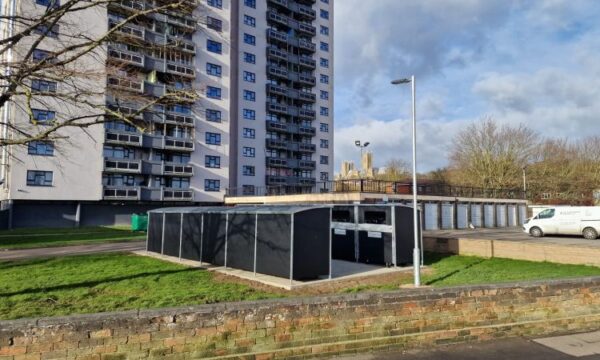
A coordinated design review considered how best to integrate secure housings into three key exit locations: East, Middle and West. The agreed approach comprised:
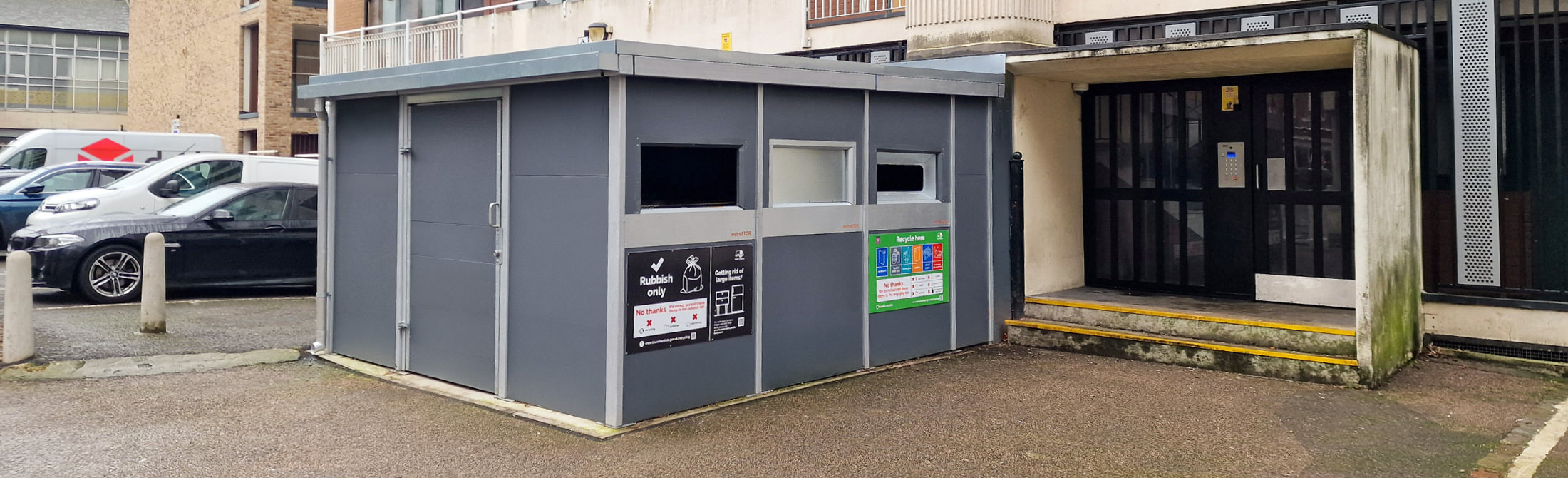
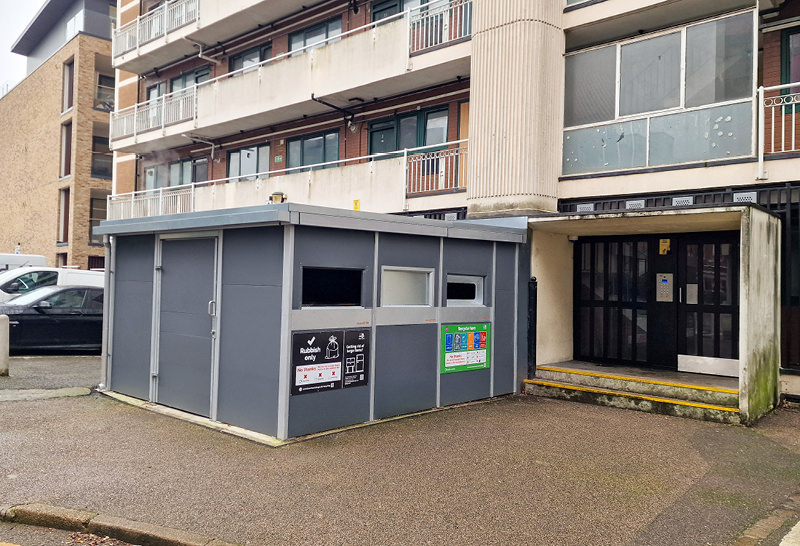
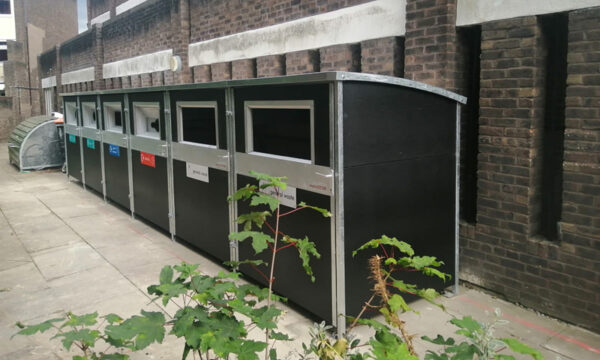
Two bespoke metroSTOR PBH units at the East and West exits, with rear interfaces designed to seal against existing building openings
A reconfigured arrangement at the Middle exit using enclosed units to replace open storage
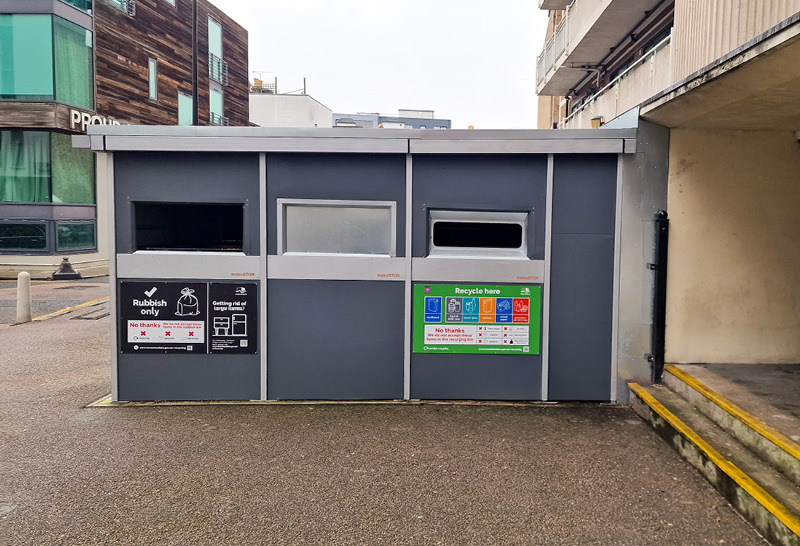
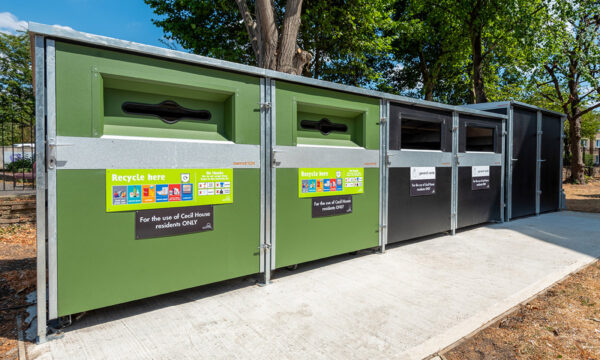
A hybrid design approach incorporating controlled apertures within PBH housings, allowing residents to deposit waste without gaining access to the internal bin area
Deflector plates and internal containment measures to manage waste drop and maintain hygiene
Concrete base installations and removal of existing bin screens
This hybrid concept enabled the required bin quantity to be stored within a compact footprint, important on a constrained urban site, while ensuring that residents could not access a shared internal space. It also allowed the caretaker to rotate chute and external bins without exposing them to public view.
Throughout the design process, the council was encouraged to review whether bin numbers could be rationalised in line with the twice weekly collection schedule, potentially reducing overall footprint and cost.
What were the results?
Control and access
Open public access to bins removed
All primary storage placed behind lockable steel enclosures
Clear separation between resident deposit points and internal operational areas
Fire and compliance
Loose bins within six metres of the building formalised within robust steel housings
Improved compliance position through defined storage areas and reduced unmanaged risk
Rodent and misuse mitigation
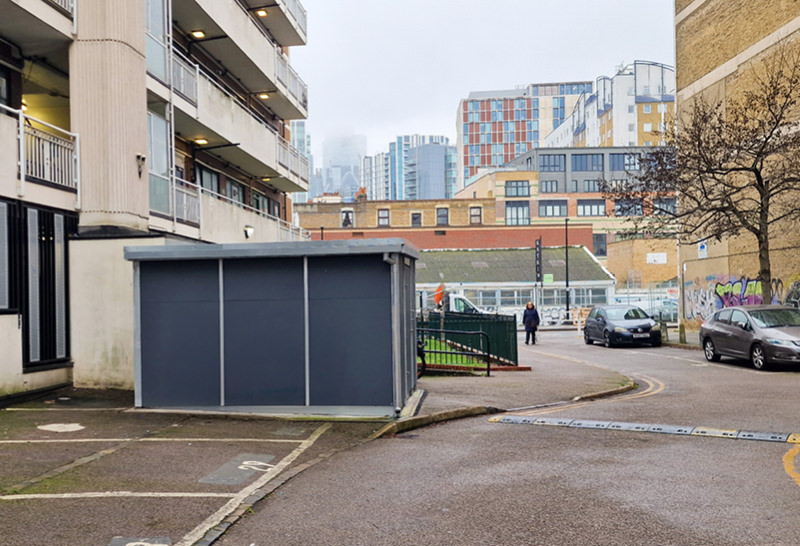
Secure, sealed rear interfaces reduce opportunities for rat ingress
Restricted access significantly limits non resident dumping
Bins removed from open roadside visibility
Operational management
Caretaker able to manage rotation discreetly
Defined collection points remain within five metres of the kerbside with drop kerbs retained
Improved clarity over true capacity demand once non-resident access is eliminated
Why metroSTOR?
The site required a solution capable of addressing multiple pressures simultaneously: rodent risk, public access, fire safety, constrained space and operational practicality.
metroSTOR PBH units provided a durable steel solution capable of interfacing directly with existing building fabric. The ability to incorporate bespoke rear panels, controlled apertures and deflector systems allowed the design to be tailored to Delafield House without departing from established product platforms.
Where alternative open aperture solutions were considered, the PBH offered stronger control over access and vermin resistance. The design also provided a potential pathway towards more standardised units, such as PBM or PBMT configurations, should bin rationalisation prove viable.
What did the project achieve?
The Delafield House scheme represents a shift from unmanaged, publicly accessible bin storage towards a structured, secure and caretaker controlled system.
By enclosing bins within defined steel housings and removing open roadside storage, the council has strengthened its position on fire safety, environmental quality and neighbourhood management. The project also creates a clearer baseline from which true waste demand can be assessed, once non resident use is curtailed.
Next steps
With installation complete, the key next step is monitoring. As access is controlled and non-resident dumping reduced, Tower Hamlets will be able to review bin capacity against actual twice weekly collection volumes.
This will inform whether further rationalisation or standardisation is appropriate, and whether the Delafield House model can be replicated across similar estates facing rat pressure, public access and compliance concerns.
This file is currently not available for download.
Get a Quote - metroSTOR UK
We use cookies to ensure that we give you the best experience on our website. If you continue to use this site we will assume that you are happy with it.
To provide the best experiences, we use technologies like cookies to store and/or access device information. Consenting to these technologies will allow us to process data such as browsing behavior or unique IDs on this site. Not consenting or withdrawing consent, may adversely affect certain features and functions.
Functional
Always active
This enables us to personalize our content for you, greet you by name and remember your preferences
Preferences
The technical storage or access necessary for the legitimate purpose of storing preferences that are not requested by the subscriber or user.
Analytical/performance cookies
They help us track visitor numbers and understand how users navigate our site, allowing us to improve its functionality and ensure users find what they need easily.The technical storage or access that is used exclusively for anonymous statistical purposes. Without a subpoena, voluntary compliance on the part of your Internet Service Provider, or additional records from a third party, information stored or retrieved for this purpose alone cannot usually be used to identify you.
Marketing
The technical storage or access is required to create user profiles to send advertising, or to track the user on a website or across several websites for similar marketing purposes.