Table of Contents:
Understanding fire risk in external works
External works form a critical part of a building’s fire strategy, particularly in residential and mixed-use developments where bin stores, cycle parking and general storage are often located close to occupied buildings.
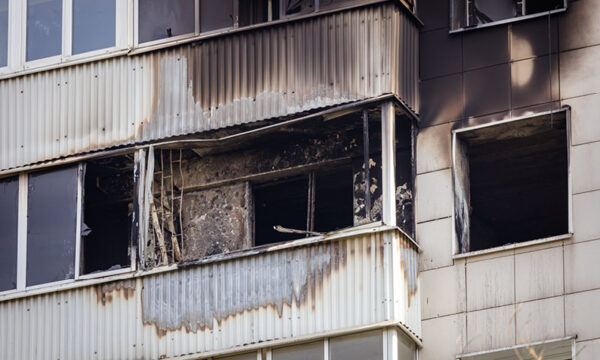
Waste containers positioned against façades, unsecured storage areas and present well-recognised ignition and spread risks. Fire services across the UK continue to document incidents where external fires have travelled rapidly into homes through windows, doors and eaves because containers or stores sat directly against the building line.
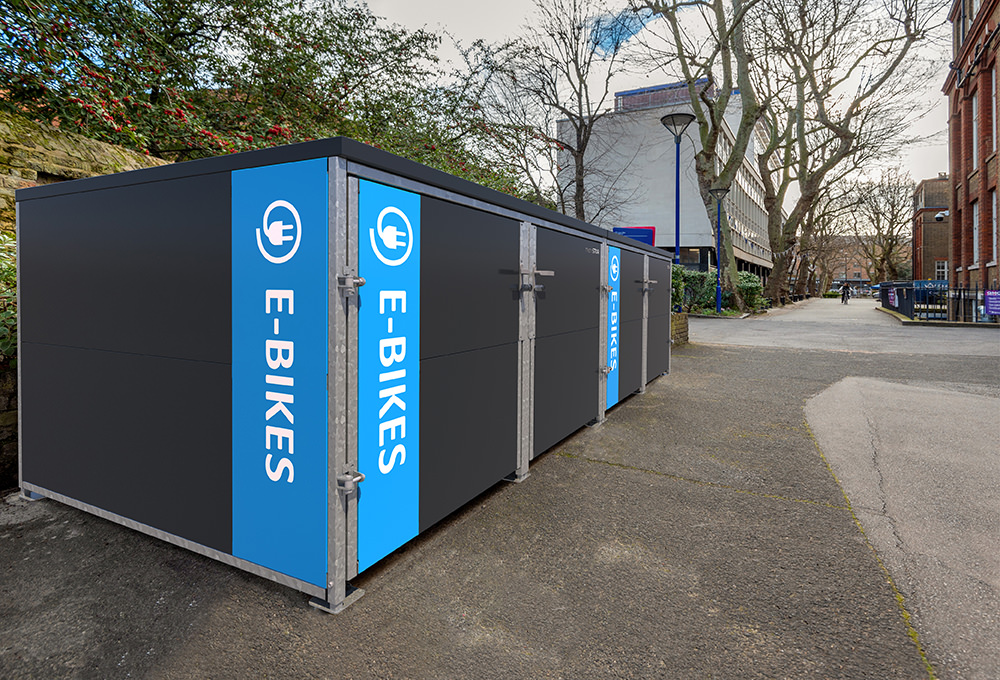
The rise in lithium-ion battery fires adds further complexity, with e-bikes and e-scooters now linked to some of the fastest-growing fire risks in the built environment. Where devices are stored or charged in inappropriate locations, the consequences can be severe.
Regulatory context and design responsibility
There is no single piece of legislation defining minimum distances for external storage, so architects must adopt a risk-based approach supported by established guidance.
Key references include:
General best practice recommends that bin stores and any cycle storage with charging provision are located at least 6 metres from residential buildings. Where the 6-metre separation cannot be achieved, fire-resisting construction becomes essential. Guidance typically calls for a minimum of 30 minutes’ fire resistance, with many insurers now recommending 60 minutes for e-bike and e-scooter charging areas.
Communal escape routes present additional design risk. The Home Office advises that waste storage should be approached directly from the open air, be permanently ventilated and be fully separated from protected stairways and lobbies.
Designing out ignition and fire spread
Design decisions in external works can significantly reduce the likelihood of fire starting or spreading.
Key principles include:
- Separation distance: Aim for 6–10 metres between stores and residential façades wherever possible.
- Non-combustible construction: Avoid combustible cladding and roofing; specify non-combustible or fire-resisting systems where proximity is unavoidable.
- Fire-resisting separation: Use EI-rated roofs, walls or internal compartments when required by risk assessment.
- Surveillance and security: Lockable stores, controlled apertures, good lighting and natural surveillance deter arson and reduce fire loading in public spaces.
- Protection of escape routes: Ensure stores do not obstruct or sit adjacent to entrances, exit routes, stair cores or windows to habitable rooms.
Ventilation: Provide permanent ventilation for any enclosed waste or e-mobility storage areas to prevent heat accumulation and aid smoke dispersal.
Embedding these principles early helps create safe, compliant and easier-to-manage external environments.
E-mobility devices and the growing battery risk
Lithium-ion battery fires associated with e-bikes and e-scooters are rising sharply across the UK. Thermal runaway can develop in seconds, producing intense heat and flammable gases.
Key risks include:
- Storage or charging near entrances and escape routes
- Unventilated or enclosed cycle stores
- Devices using uncertified or modified batteries
- Communal areas used as informal storage because of inadequate provision
London Fire Brigade analysis indicates that around 40% of e-bike fires involve unsafe conversion kits, while nationwide trading standards bodies report a sharp increase in fires linked to counterfeit online products.
Designers must consider adequate ventilation, clear separation from buildings and safe charging layouts. Avoiding placement near doors, windows or protected routes is essential, particularly in high-density housing.
Specification in practice
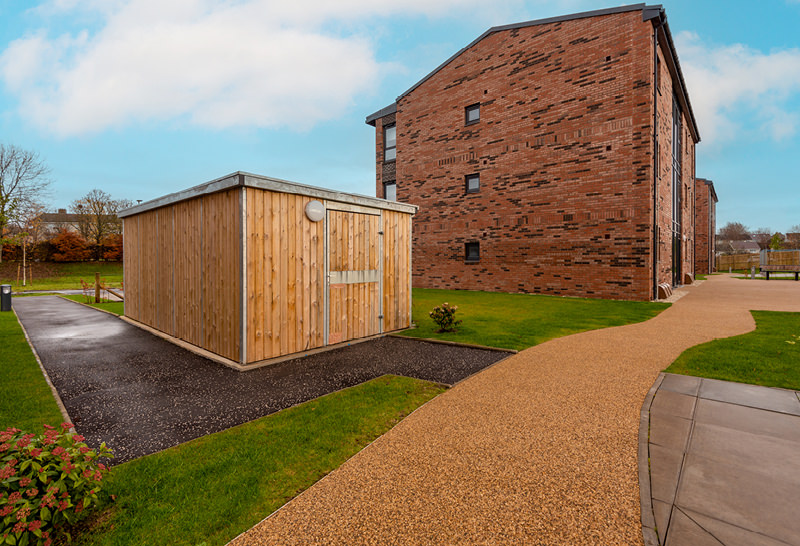
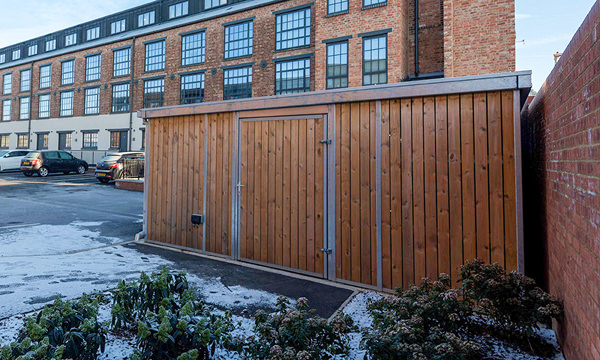
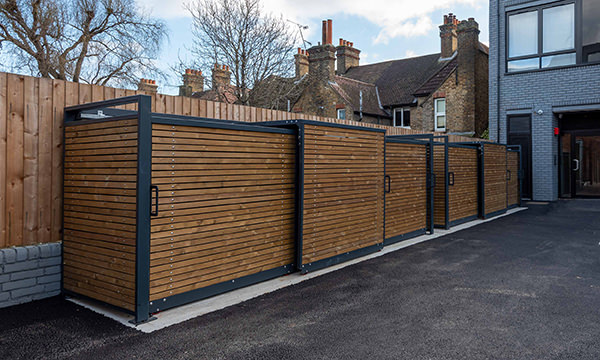
metroSTOR systems support architects in delivering fire-safe external works through pre-engineered, regulation-ready solutions.
Features include:
- Non-combustible construction across bin stores and cycle hubs
- Fire-resisting options for roofs and walls when separation is limited
- Ventilated layouts for waste stores and e-mobility parking
- Lockable, secure units that reduce arson opportunity and manage fire loading
- BIM and NBS integration for accurate modelling and documentation
- Supporting technical data to assist with Building Control and planning submissions
Where project constraints require bespoke solutions, the metroSTOR design support team can advise on layout, separation strategies and specification of fire-resisting elements.
Coordinated external works for safer developments
Fire safety intersects with waste management, cycling provision, security and accessibility. Treating these elements as isolated problems increases risk and adds complexity during planning.
metroSTOR enables architects to coordinate bin stores, cycle parking, canopies and public realm structures as part of a unified external works strategy. This improves consistency, simplifies compliance and helps avoid late-stage redesign.
With evolving regulatory expectations and increasing scrutiny of fire safety in residential environments, early design-led decision making is crucial. Integrating fire-safe external works from the outset not only supports compliance but also contributes to safer, more resilient communities.